


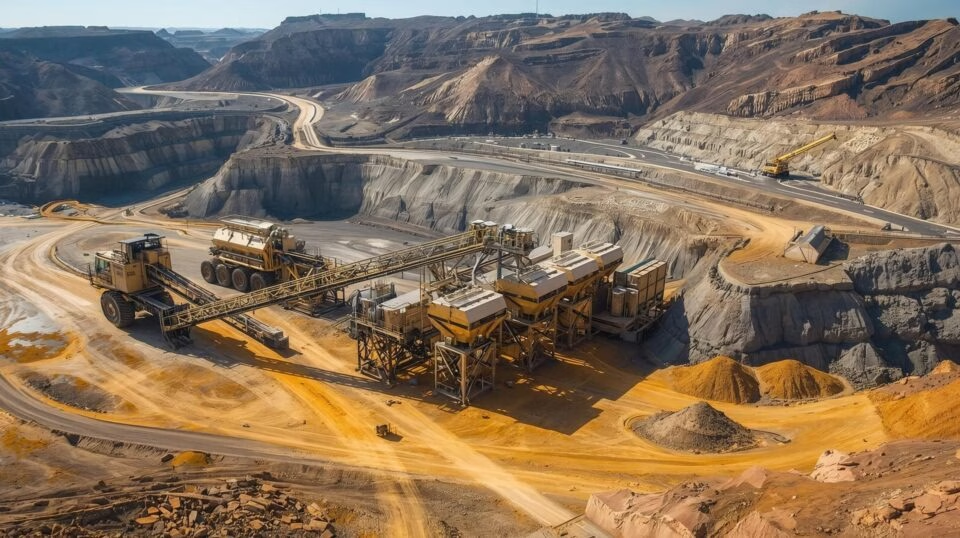
In a strategic move that secures both its economic future and its environmental credentials, the Navachab Gold Mine near Karibib is reaping monumental benefits from a cutting-edge, dry-sorting technology partnership. The mine, a significant contributor to Namibia’s gross domestic product, has successfully upgraded its very low-grade ore resources, effectively turning what was once considered waste into profitable ore and doubling the gold grade sent to its processing plant.
This transformation is driven by a suite of innovative, sensor-based sorting systems supplied by global provider STEINERT. The technology’s low operational costs—a mere quarter of the previous Dense Media Separation (DMS) method—coupled with its minimal water requirement, positions it as a cornerstone for the future of sustainable and profitable mining in Namibia.
The journey began in 2016 when Navachab first installed STEINERT XSS T sorters. Over the past decade, these robust machines have preconcentrated over ten million tons of low-grade stockpiles, material previously deemed uneconomical to process. Now, the mine has taken the next evolutionary step, installing STEINERT’s latest multi-sensor generation to drive recovery rates even higher.
A Holistic Vision for a Mine’s Future
The man central to championing this technological shift is Hildbrand Wilhelm, a seasoned veteran with decades of senior management experience at Navachab. On a Friday morning in Swakopmund, Wilhelm, whose role has evolved to focus on proposing the mine’s long-term future, reflected on the mindset that made this progress possible.
“As a young engineer, I was forced to question the status quo. That was how I was brought up,” Wilhelm stated. He applied this principle to Navachab’s unique circumstances, leveraging a deep understanding of available technologies and holistic thinking to select the most promising treatment routes.
“The more of a holistic view you have, the better you can decide what technologies can work, as long as you understand these technologies,” he explained. This philosophy led to the adoption of dry sorting, which compared to the previous DMS process, now runs at a quarter of the overall operational costs while simultaneously doubling throughput. The fact that the process is waterless was another critical factor in its selection, a key advantage in an arid country like Namibia.
The Evolution: From Single Sensor to Intelligent Multi-Sensing
The latest chapter in this partnership involves upgrading from single-sensor to a sophisticated multi-sensor system. Wilhelm recalls that the former STEINERT systems were incredibly robust, reliably withstanding ten years of harsh and dusty mining conditions. However, he identified the true potential lay in the software.
“I think the computer programs hold the key to sorting. The most important thing is that the machines can be taught, which is what STEINERT has done very well,” Wilhelm said, paying a compliment to the engineers behind the technology.
This collaborative relationship was crucial. Wilhelm, a metallurgist who would never support an idea whose science he didn’t understand, found a valuable sounding board in STEINERT Solution Manager in Mining, John Knouwds. The two first crossed paths 25 years ago as students.
”Having somebody available that can help develop your thoughts and that you can bounce ideas off helps a lot,” confirmed Knouwds.
As STEINERT’s detector technology advanced, the mine seized the opportunity to test its ore’s response to a combination of sensors. The test results confirmed significant potential for improved gold recovery, paving the way for the decision to incorporate the new multi-sensor technology when it was time to replace the original machines.
Breaking Through the Throughput Barrier
A key innovation that enables this new efficiency is a sophisticated software solution for data interpretation. In traditional particle sorting, higher throughput can lead to “clustering,” where multiple rocks are identified as a single particle. This can cause costly errors, misclassifying valuable ore as waste or vice-versa.
STEINERT’s Intelligent.Declustering software solves this problem. It digitally extracts individual rocks from a cluster, even when they are tightly packed, and analyses them separately. This ensures accurate classification and allows the system to process higher volumes without sacrificing recovery rates. This breakthrough makes previously incompatible goals—higher speed and greater accuracy—achievable together.
The KSS EVO 6.0: Engineering for Efficiency
The new installation at Navachab is based on the STEINERT KSS platform, now updated to the EVO 6.0 version. While the core concept is proven, the latest iteration focuses heavily on operational ease and maintenance efficiency.
The machine has been designed with the operator in mind. Maintenance personnel can simply walk inside the machine for inspection. An integrated rolling platform provides quick and safe access to critical components like the valve bar and conveyor belt. The valve bar itself can now be swung upwards to prevent clogging during maintenance. Furthermore, a permanently integrated railing with ladders allows for swift and safe access to the 3D and colour sensors, eliminating the need for special climbing gear.
Profitability Paired with Long-Term Responsibility
For Wilhelm, this technological advancement is not just about immediate profits; it is about securing the mine’s legacy and fulfilling its social contract. “We are now working to ensure that the mine has a very long life. One of the big concerns is how to empower the youngsters who are going to take over from us,” he said.
He highlighted the mine’s ongoing support for schools, universities, and bursary programmes, affirming that “Navachab will carry on running as long as we are smart about things. After all, the gold is there.”
As the visit concluded, Wilhelm shared a confident prediction for the entire industry. “In 25 years, there will be sorting technology in every processing plant because sorting technology is the cheapest technology of all the technologies that are available in terms of operating costs. Ore bodies are becoming lower in grade, meaning sorting will only gain in importance.”
With its forward-thinking adoption of dry sorting, Navachab Gold Mine is not just extending its own life; it is charting a viable, cost-effective, and environmentally conscious path for the future of Namibian mining.
