


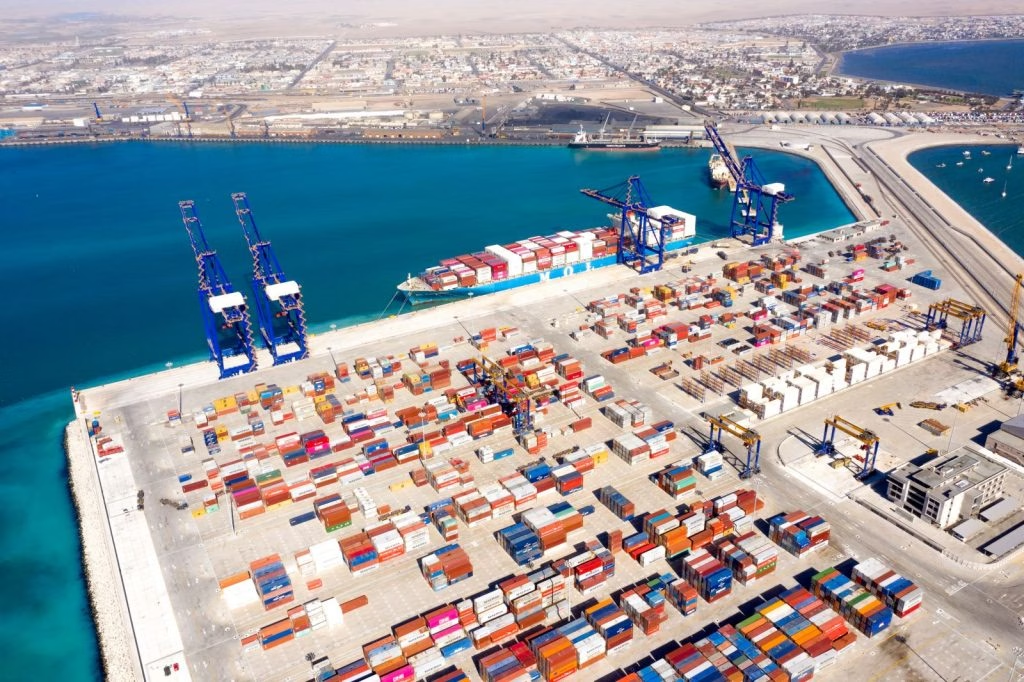
The Namibian Ports Authority (Namport) recently signed a Letter of Intent (LOI) with the South Korean Ministry of Oceans and Fisheries in February to help the state-owned enterprise achieve climate goals through the International Port Cooperation Development Programme (IPDCP).
The IPDCP was launched in 2008 and has been a long-running project to help nations achieve green port functions.
Namport is set to receive assistance in the development of the port authority’s Green Port Policy, a 10-year Green Port Investment Plan, and a Green Port Implementation Roadmap. This was confirmed in the joint statement released by both parties, wherein they state that Namibia is a ‘flagship beneficiary’ of this programme.
“Namibia is set to benefit from the IPDCP, which is a strategic partnership between the African Development Bank (AfDB) and the Korean Ministry of Oceans and Fisheries,” the statement outlined.
This project falls within the UN’s scope of meeting all climate-related goals by 2030. This is as the International Maritime Organisation (IMO) has set its own targets under the UN umbrella for member states to tackle the fuelling needs of shipping at ports and harbours, but also to facilitate the role played by coastal facilities in the ‘Green Agenda’ of the world.
THE GOALS
How the harbours and ports actually achieve these goals in terms of lowering the greenhouse gas emissions is the main aim, as the IPCDP outlines that South Korea has been a leader in developing this overall strategy.
“The program is an initiative that allows the Korean MOF to establish win-win partnerships in the field of port development between Korea and partner nations,” indicates a strategy document from the Korea Ports & Harbour Association.
Since the project affiliated to Namport will be under the auspices of the Namibian government, the AfDB, and South Korea, the first step of signing the LOI could only commence when bilateral relations and multilateral platforms like the continental development bank endorsed the initiative.
“Namport’s board resolved to transition the ports of Walvis Bay and Lüderitz into fully fledged, future-proof green ports. This is as Namibia is set to be at the forefront of Africa’s green maritime transition,” stated Namport CEO Andrew Kanime.
These ports are set to become more dynamic in their functions associated with green port management.
“They will be greener through renewable energy adoption and be able to reduce emissions. The ports will also be cleaner through enhanced air and water quality management, while championing safety through strengthened climate resilience,” indicated the joint statement.
Increased competitiveness through sustainable innovations associated with the ports and harbours formed part of the goals, along with the facilities being more responsible in their protection of surrounding ecosystems and communities.
According to the Korean Ports & Harbours Association, partner nations are eligible for funding ranging from US$600,000 to US$800,000 per project.
The cooperation in this document notes that partner nations can look forward to port modernisation and redevelopment, coastal regeneration, hinterland development, new port technology adoption, maritime transportation-related infrastructure development, and fisheries infrastructure-related developments.
BROADER PICTURE
Korea’s MOF outlined an overall strategy currently in play for the 2021-2030 period, where the Asian country is aiming to be a major player in the ‘Green Ship’ development.
“This strategy explores advanced emission-free technologies which enable the phasing out of greenhouse gas (GHG) emissions up to 70 percent by 2030 in such an arena as ship design, future fuel, renewable energy, equipment, and so on,” the MOF noted.
Countries in the EU have been testing and using water transport modes with alternative power solutions, like hydrogen-powered barges on the Nieuwe Maas river that runs through Rotterdam, Netherlands.
According to the IMO, maritime transport only contributes to 3% of the global carbon emissions annually. That said, there have been notable shifts from fossil fuel usage to biofuels and other renewable sources.
The UN Conference on Trade and Development (UNCTAD) noted that “this transformation requires significant investments in dedicated infrastructure, safety systems, regulatory alignment, multi-stakeholder collaboration and workforce upskilling.”
The agency also noted that “For many developing nations, the shift to low-carbon ports is slowed by the absence of integrated strategic frameworks, fragmented institutional mandates and weak coordination among port authorities, energy providers and regulators.”
